



Artificial Intelligence: A God That Never Withdraws?
Industrie, Tech & Innovation
“Artificial intelligence will never be able to…” How often do we hear these words around us? How often do we utter them ourselves? Artificial intelligence will never be able to… As if we were seeking reassurance, as if we were trying to convince one another. If, as Charles Péguy once wrote, “nothing is perhaps as old as today’s newspaper,” then nothing is quite as provisional as this creed we repeat to ourselves all day long: “artificial intelligence will never be able to…”
For the truth is that technological progress has become so spectacular that it is gradually opening the door to every possibility. As a result, the question today is no longer a technical one—it no longer truly is. It is, instead, philosophical, political, religious, economic, moral and ethical.
The Debate Is No Longer Technological
We take refuge behind false technical barriers. We indulge in absurd debates – is this intelligence really intelligent? And, after all, what is intelligence? – as though we lacked the courage to confront the real, dizzying questions raised by artificial intelligence.
The question of a world in which AI would evolve from being a legitimate alternative interlocutor to becoming the only legitimate interlocutor. The question of a world in which our identities would be transformed: if, as Aristotle suggested, “I am what I do, and I become what I repeatedly do,” and if, as René Descartes famously wrote, “I think, therefore I am,” then what will I become as I increasingly delegate both my actions and my thinking to AI?
The question of a world in which scientific progress – at once the father, brother and son of technical and technological progress – turns the gap between technological advancement and human advancement[1] into an abyss.
Can We Still Give Meaning to Progress?
During the Age of Enlightenment, the eighteenth century, the philosopher Immanuel Kant warned that our capacity to think exceeded our capacity to know. Today, however, we find ourselves in the opposite situation: our capacity to know exceeds our capacity to think.
There is such an abundance of new knowledge, scientific discoveries and innovations emerging across the world that we can no longer truly “think” them. To think them means to make them our own and, in a sense, to humanize them. To know, but how far? To innovate, but for how long?
Perhaps never before have States, businesses, and more broadly every form of collective work, and human beings overlapped so completely in confronting the same question. For all of them, nearly identical challenges arise.
What does artificial intelligence do to my values, my projects, my decisions and my actions? What will I choose to delegate to it, and what will I choose not to? What place does it leave for me? Will I allow it to define me, or will I defend my uniqueness? And what exactly is that uniqueness? Will AI become a force for easing human relations, a tool for bypassing otherness, or a catalyst for heightened conflicts and competition?
What Will Remain of Our Uniqueness?
Omnipresent, omniscient, and soon omnipotent through robotics, AI is gradually acquiring all the attributes of divinity[2]. It is as though it were made not in the image of humanity, but in the image of God; as though its ambition were not to replace the former, but the latter.
This new divinity, accessible to all, without clergy, without ritual, without liturgy, but not without sacrifice, answers every prayer our prompts have become. Yet it presents us with a profound dilemma: that of a god who, unlike the God of the Bible, does not withdraw, does not rest, does not disappear in order to make room for humanity.
If tomorrow AI can do everything, what will remain for us, States, businesses, human beings? What, then, will we still be able to do?
[1] Gabrielle Halpern, « Créer des ponts entre les mondes – Une philosophe sur le terrain », Fayard, 2024.
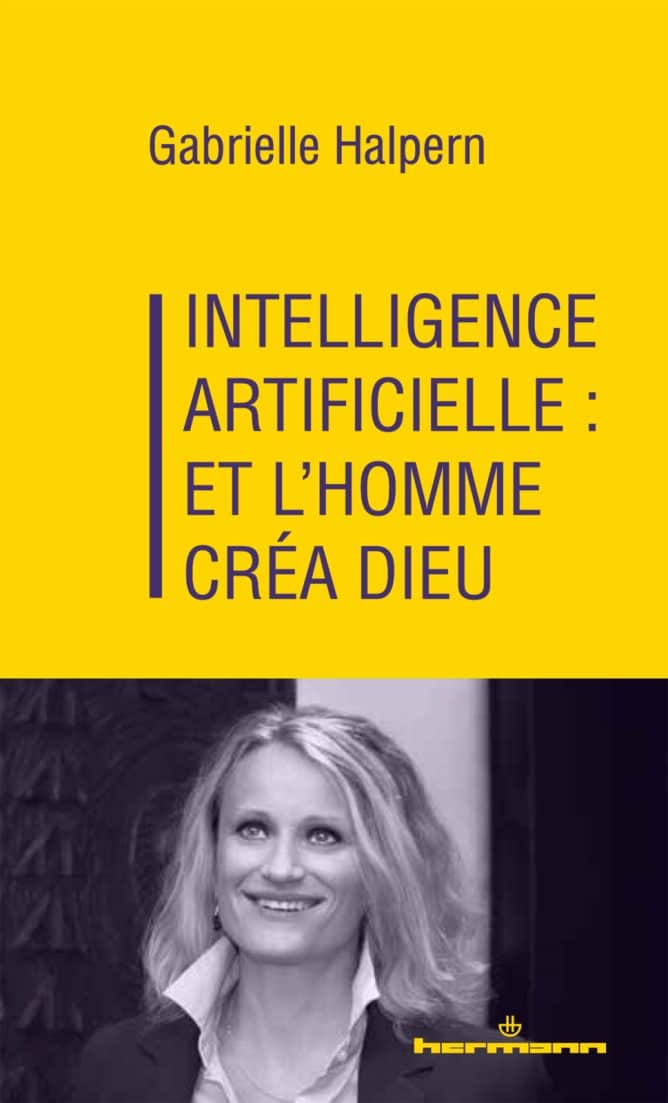
[2] Gabrielle Halpern, « Intelligence artificielle : et l’Homme créa Dieu », Hermann, 2026.