


Global Economic Dialogue
The Rencontres Économiques d’Aix-en-Provence have created the Global Economic Dialogue, an international platform designed to confront and renew economic thinking in the face of geopolitical shocks and global transformations. A place for exchange between think tanks and decision-makers.
One ambition: to bring ideas together to rethink the global economy in the face of shocks
In recent years, traditional frameworks of economic and political thought have increasingly lost their relevance. This has led to an unprecedented need to understand the new world that is emerging.
It is from this observation that the Global Economic Dialogue was born, a unique space for collective reflection, bringing together think tanks from around the world with different and sometimes contradictory views on the changes in the global economy.
This unique initiative aims to demonstrate that dialogue is possible, despite differing analyses of major contemporary issues: energy transitions, geopolitical realignments, the future of work, social justice, the role of the state, and democratic challenges.
Far from promoting a uniform vision, the Global Economic Dialogue encourages the productive exchange of ideas. It provides a forum for discussion where the major currents of thought today—whether conservative, liberal, social democratic—can come together. It is a space where disagreements are as illuminating as points of convergence.
Because we cannot think about the economy solely from the perspective of France or Europe, because no single model can provide the answer to global challenges on its own, we chose to give a voice to intellectual institutions from all regions of the world, committed to a demanding and constructive dialogue.
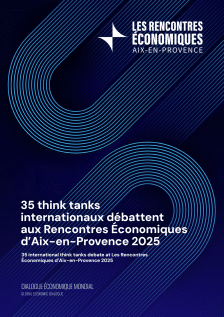
The 2025 Global Economic Dialogue Report
Following the first edition of the Global Economic Dialogue, le Cercle des économistes has published its initial assessment. 35 think tanks from all continents confront and compare their analyses.
This report reaffirms the value of plural perspectives and demonstrates that only a diversity of approaches can help us grasp the fractures reshaping the global economy.